
Birt-Hogg-Dubé Syndrome Clinical Trials
23 Aug 2026
BHD has been recognised for decades, but unfortunately often due to underfunding it remains a relatively under-researched condition, and there is still more work to be done to understand why people with the same genetic condition can experience very different symptoms.
People living with BHD often have questions about what research is taking place, whether clinical studies are available, and whether researchers are getting closer to developing treatments that target the underlying causes of BHD.
Because BHD is rare, research can be challenging. There are fewer patients available to take part in studies, and researchers often need to work internationally to collect enough information to understand the condition properly.
Importantly, not all clinical research involves testing a treatment. Some studies look at the natural history of BHD, some investigate genetics, while others explore very practical questions about living with the condition.
We have brought together some of the key BHD-related studies registered on ClinicalTrials.gov, alongside some of the wider research that is helping us understand BHD.
Why is BHD research important?
Although we know that BHD is caused by changes in the FLCN gene, there is still much to learn about exactly how those changes cause the different features of the condition.
Researchers are continuing to investigate questions such as:
- Why do some people with BHD develop kidney tumours while others do not?
- Why do some people experience pneumothorax?
- What causes the characteristic lung cysts?
- Why do fibrofolliculomas develop?
- Does the specific FLCN mutation influence how BHD affects an individual?
- How does BHD change over time?
- Can we eventually develop treatments that target the underlying biology of BHD?
Natural-history studies and patient registries are particularly important because they allow researchers to collect information from larger numbers of people with rare conditions
Current and recent BHD trials
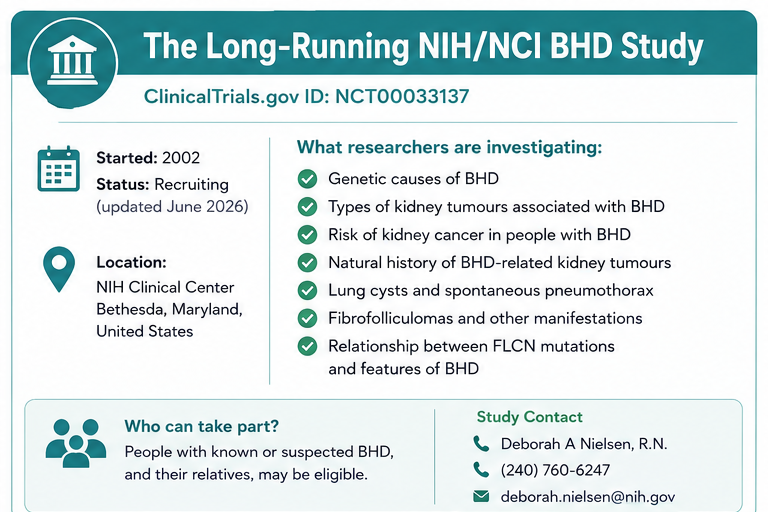
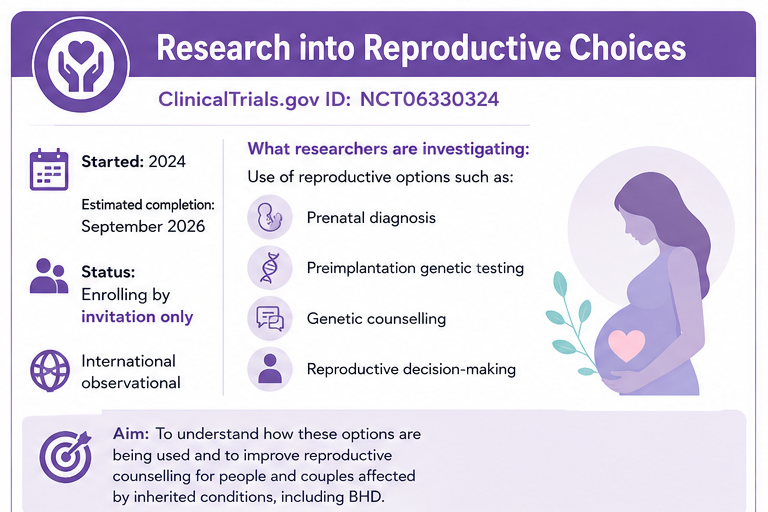
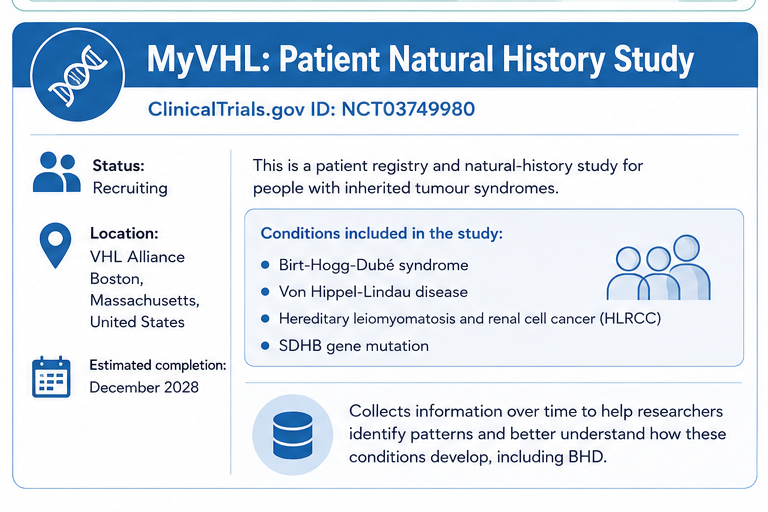
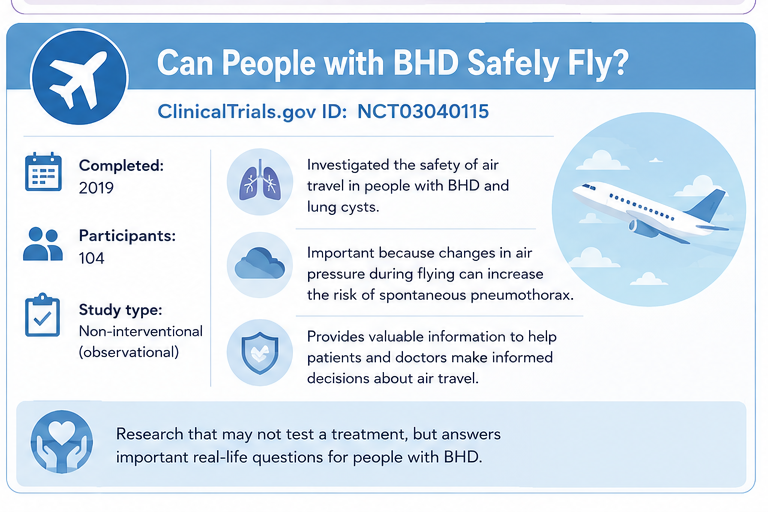
Below are four studies that are particularly interesting to the BHD community.
We have created an individual infographic for each study. Click on each infographic on to view the full study information on ClinicalTrials.gov.
What we know about FLCN
One of the ways researchers are beginning to understand BHD is by looking at what happens inside cells when FLCN is not functioning normally. In simple terms:
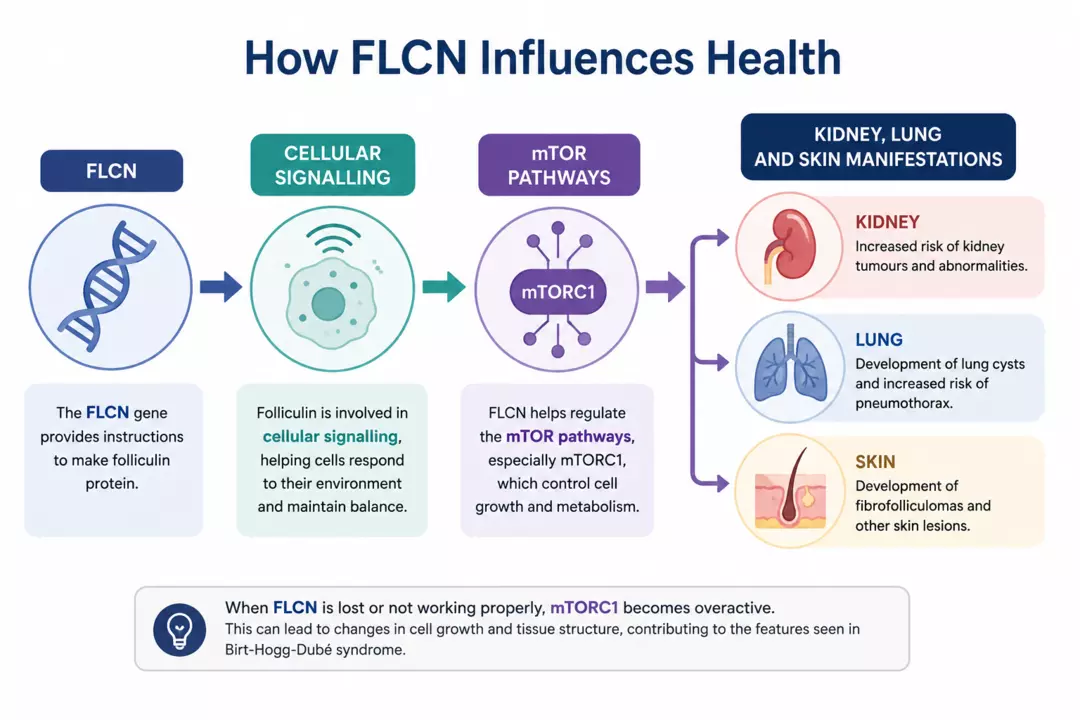
Why don't we have a treatment for BHD yet?
At present, there is no treatment that can correct the underlying FLCN mutation and cure BHD.
Instead, medical care focuses on monitoring and managing the different manifestations and risks associated with the condition.
For example, people with BHD may require kidney surveillance, while lung and skin manifestations are managed according to individual circumstances.
Developing a treatment for a rare genetic condition is challenging.
Researchers need to understand:
- the biology of the disease;
- how the condition changes over time;
- which manifestations can be prevented;
- which pathways could be targeted;
- and whether potential treatments are safe and effective in people.
That is why natural-history studies, patient registries and laboratory research are all important.
Why patient participation matters
For a rare condition, every patient who takes part in research can make a difference.
Research participation might involve:
- providing genetic information;
- completing questionnaires;
- sharing medical information;
- having scans or other investigations;
- providing blood or other samples;
- or taking part in long-term follow-up.
Not every study involves treatment.
Sometimes the most valuable contribution is simply helping researchers understand what living with BHD looks like over time.
The more researchers learn about BHD, the better placed they will be to identify patterns, improve monitoring and develop new approaches to treatment.
Supporting BHD research
The BHD Foundation is committed to supporting research and helping connect the BHD community with researchers where appropriate.
If you are a researcher working on BHD and would like to reach people outside your existing patient network, please contact the BHD Foundation.
With appropriate permission from the research team, we may be able to share information about relevant research opportunities with our patient community.
We believe that researchers, clinicians, patients and patient organisations working together can help accelerate progress in BHD.
Important information
This article is intended for information and awareness purposes only and is not medical advice.
Clinical study information can change, including recruitment status, eligibility criteria, locations and contact details. Anyone interested in taking part in a study should check the current ClinicalTrials.gov record and contact the research team directly.
The studies discussed in this article include observational studies, patient registries, natural-history research and clinical trials. Inclusion of BHD in a study does not necessarily mean that every person with BHD will be eligible.
Back to